
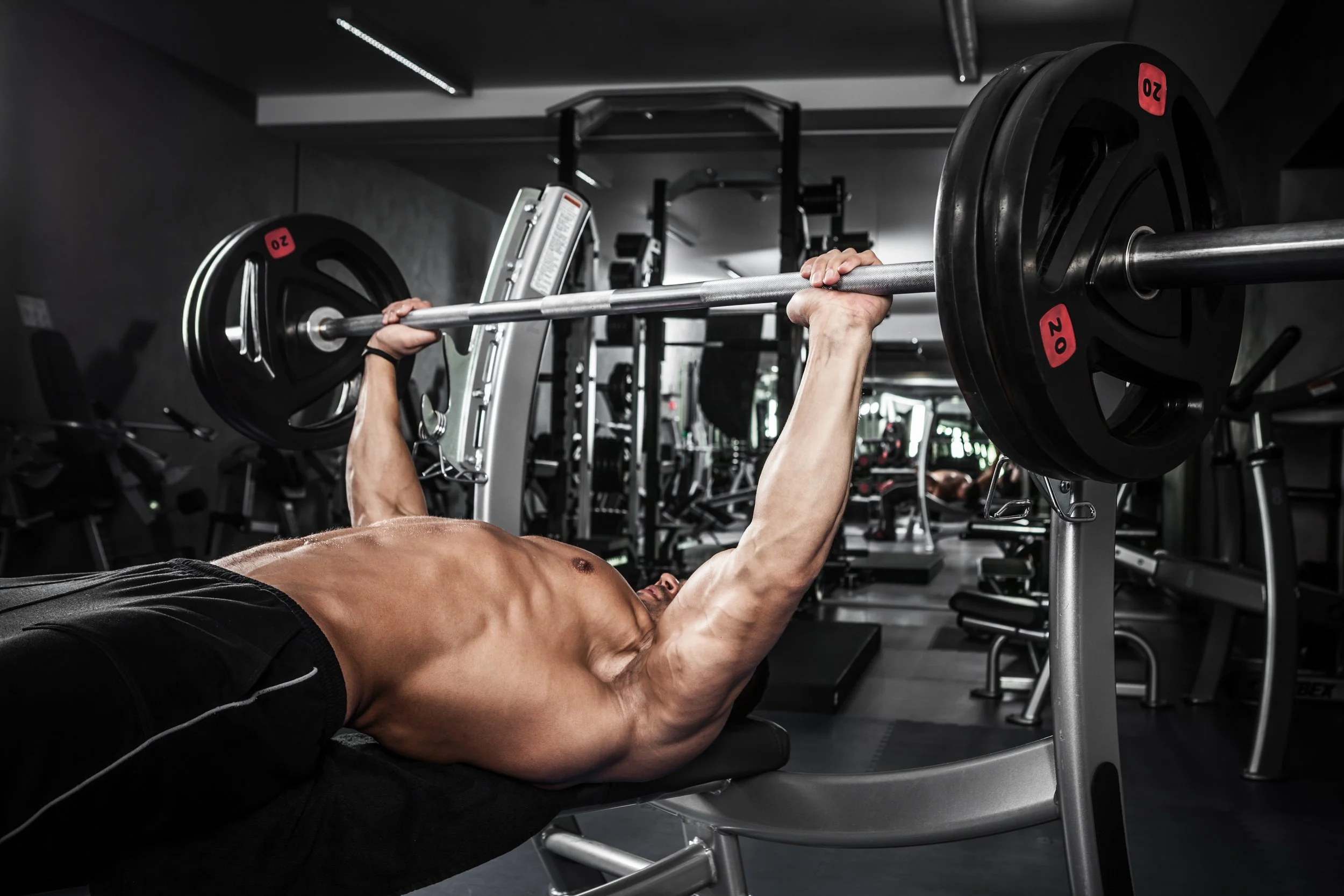
Let's go over form and technique on the bench press. Now I may sound a little basic here but the bench press is my favorite exercise. Just like with all lifts, getting the technique right is going to keep your body healthy and make you more powerful in the lift. Let's get into it.
Getting Into Position
Start by sitting on the edge of the bench. We dont want you smacking your head when you are lying back. Once you lay back position yourself with your eyes lined up just above the bar. We do not want you working too hard to unrack the weight. This limits how far the bar has to travel to get into your start position while also allowing you to be in a position where the bar will not hit the j-hooks on the way out. Too far above the bar and you risk hitting the j-hooks during your set. Too far away and it will pull your shoulder blades out of position and cost you energy before you even start pressing.
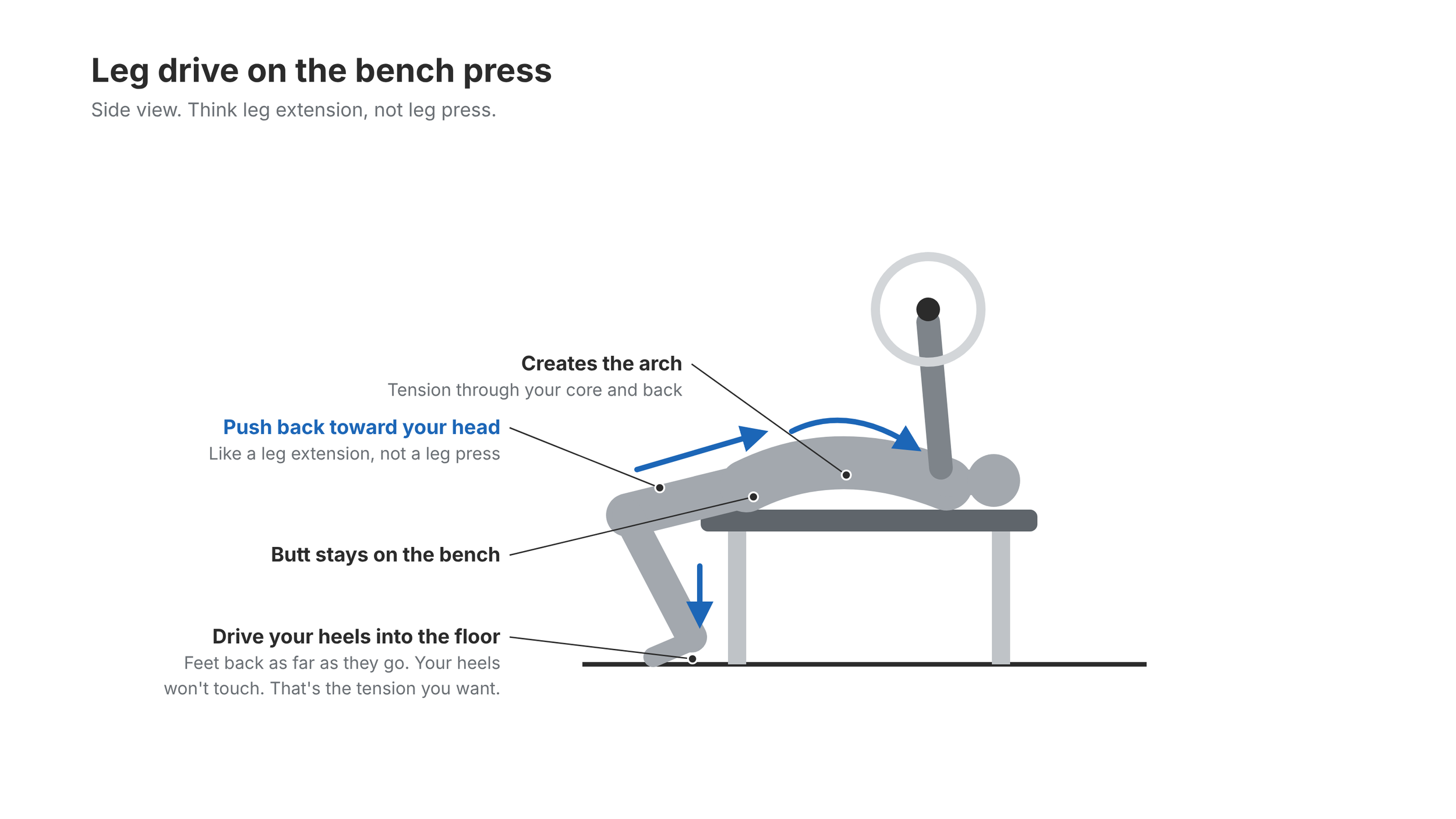
Now that you are lying in place let's talk about getting your feet into position and creating good leg drive. A common thing I see is people lying in the bench press with their feet flat on the floor. There is not necessarily anything wrong with that but we can get into a better position. One thing I want you to think about when it comes to leg drive is to think of it as more of a leg extension rather than a leg press. You will see a lot of people with their butts raising off the bench and a lot of times that is because they are driving their feet straight down into the floor. Here is how I like to cue foot position in a way that is pretty much impossible to mess up. Once you are lying in position bring your feet as far back as they possibly can go. Be pretty extreme about it. Your feet will now be in a position where they cannot fully touch the floor. For your entire set drive those heels into the ground. Your heels will not be able to touch but that is going to create the force and tension we want from your legs. This will help create the arch in your back and help generate the force we need to maintain through your core and back throughout the movement. One extra note here, if you find that when you apply leg drive you start sliding up the bench, then you are doing a good job. The way I like to counteract this so I do not slide off the bench is to loop a resistance band on the bench to create friction so I cannot slide off.
Now that your legs are in position let's get your shoulders set. You want to retract and depress your shoulder blades. Think about squeezing a pencil with the center of your back and then pulling your shoulder blades down into your back pockets. Think of it as creating a bed with your scapula to lay on and press from.
Here is why this matters for your shoulder health. When you bench press the bar wants to jam your shoulder blades out of position on every rep. If your scapula is not locked in before you start pressing it gets forced into a position that puts serious stress on the shoulder joint. Unlike push ups, dips, and dumbbell press where the scapula can move freely through its natural range, the barbell bench press does not allow for that. Set your shoulder blades before you unrack and do not let them move for the entire set.
Grip and Bar Position
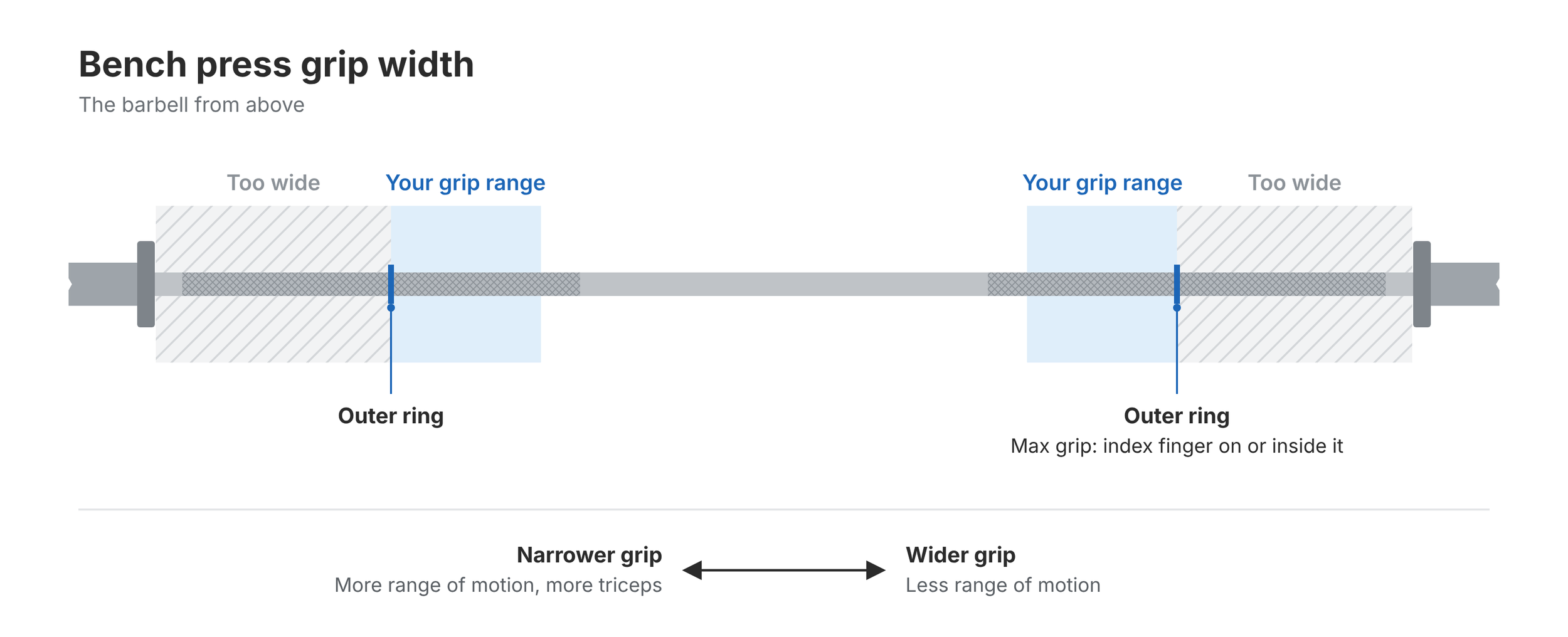
Grip width is going to vary from person to person but there is a maximum. Your index finger should be on or inside the outer ring of the barbell. Going wider than that is not going to help you lift more weight and it increases injury risk. If that grip feels too wide for you bring your hands in slightly until you find a position that feels strong and comfortable.
A wider grip reduces your range of motion which is why some people gravitate toward it when they are chasing heavier numbers. A narrower grip increases range of motion and places more demand on the triceps. Neither is wrong. Find the grip width that feels strongest for you within that range.
The Arch
The arch in the bench press is a topic that confuses a lot of people. Let's clear it up. The arch is a natural result of getting your body into the strongest and safest position possible for the lift. When your feet are back, your heels are pressing down, and your shoulder blades are retracted and depressed, your back will arch. That is the correct position.
In a powerlifting competition an arch is completely legal as long as your upper back, glutes, and feet maintain contact with their respective surfaces. How much arch you have depends entirely on your mobility. More arch means less range of motion on the bar. Less arch means more range of motion. If you are not a powerlifter and your goal is building muscle and strength through a full range of motion the arch is less of a priority. But the setup that creates it, feet back, heels down, shoulder blades set, is always the priority regardless of how much arch results from it.
Elbow Position
You have probably heard the cue to tuck your elbows on the bench press. When your elbows are flared out to ninety degrees you close the space between the humerus and the acromion where the supraspinatus tendon travels through. Two bones are now rubbing on that tendon and that is not what it is designed for. Tucking the elbows creates more space for that tendon to move and protects the shoulder joint. There is also a strength component. When your elbows are tucked you can recruit your lats to help stabilize and control the movement. Fully flared elbows turns your lats off entirely.
The right elbow angle is somewhere around forty five degrees from the torso. Not tucked tight to your sides and not flared out to ninety degrees. Find the position where you feel the strongest and most in control of the bar.
The Press
Once you are set up, feet back, heels down, shoulder blades retracted and depressed, grip on the bar, take a big breath and brace your core. Pull the bar out of the rack and bring it to your start position over your chest. Remember to drive your heels into the ground through the entirety of the set.
As you lower the bar think about pulling it apart. Pulling the bar apart keeps tension through your upper back and ensures you are actively controlling the weight down rather than just dropping it to your chest. Lower the bar under control to your chest and drive the bar back up.
A Final Note
I know it is easy to think of the bench press as just a chest movement. Do not forget it is also a compound lift and there are a lot of parts to it. The foot position, the heel drive, the shoulder blade position, the grip, the elbow angle. Every piece of that setup exists for a reason and when all of it comes together the bench press becomes one of the most effective and safest upper body movements you can do. Getting these right is not only going to keep you safe but also make you more powerful in the lift.
